
Summary: Ceiling cracks that return every winter aren’t a sign of structural trouble. They reappear because standard spackle and patching compounds are rigid and can’t flex with the seasonal expansion and contraction of your home’s framing. Lasting repairs require removing the failed tape, rebuilding the joint with setting-type compound, and carefully matching the existing texture. Scheduling repairs during winter months, when cracks are at their widest, often produces better long-term results.
You patched that ceiling crack last spring. It looked fine for months. Then January arrived, your furnace kicked into high gear, and there it was again.
Same spot, same frustrating line running along the drywall seam.
Recurring ceiling cracks are one of the most common concerns we hear from homeowners throughout Carmel, Westfield, and Fishers.
These cracks rarely signal serious structural trouble. With the right drywall repair approach, we can break the cycle for good.
Indiana’s Temperature Swings Put Constant Stress on Drywall Joints
Hamilton County experiences temperature ranges that test every material in your home.
National Weather Service climate records show that Central Indiana regularly swings through an 80-degree temperature range between winter lows and summer highs. That dramatic swing happens every single year, and your drywall feels every bit of it.
When your furnace runs steadily through December and January, interior humidity levels drop significantly. Wood framing members lose moisture and contract. Drywall panels, fastened directly to that framing, move along with it.
The joints where two panels meet experience repeated stress as materials expand and contract through each heating and cooling cycle. Even joints that were properly taped and mudded during original construction eventually feel the strain.
Homes built in the 1990s and early 2000s throughout our service area often feature vaulted ceilings and open floor plans with long, uninterrupted drywall spans.
These architectural features look beautiful, but they concentrate movement stress at specific joint locations. The same ceiling designs that make your great room feel spacious also create conditions where seasonal cracking becomes more predictable.
Hairline Seam Cracks Tell a Different Story Than Cracks That Shift or Spread
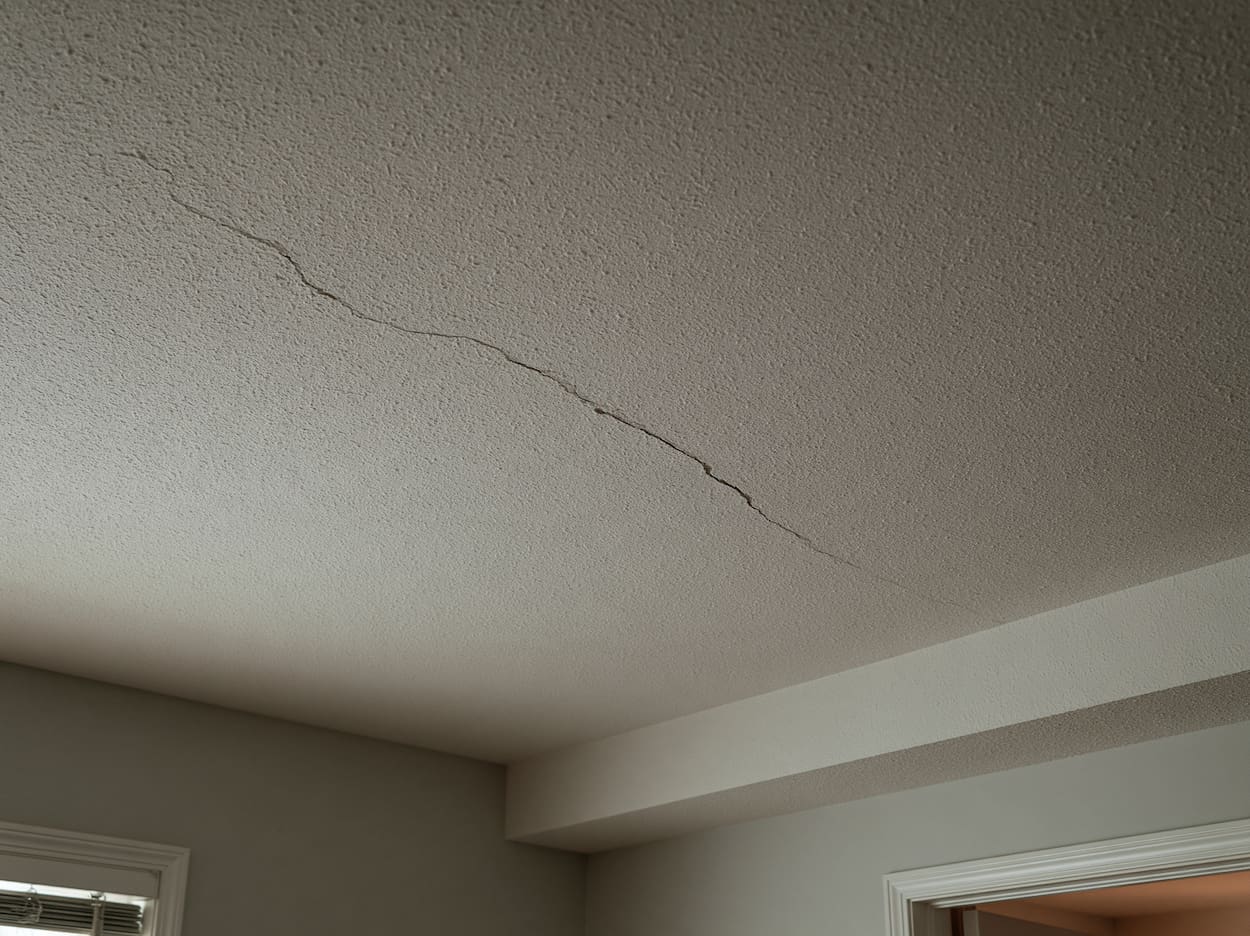
Not every ceiling crack warrants the same response. Learning to read what your ceiling is telling you helps us determine the right repair approach when we arrive for an estimate.
Hairline cracks that follow a straight path along a taped seam typically indicate normal seasonal movement. These cracks open slightly in winter when humidity drops and often close partially in summer. They look concerning, but they’re usually cosmetic and confined to the joint compound layer rather than the drywall panel itself.
Cracks that grow wider over successive years, branch into multiple directions, or appear accompanied by visible sagging deserve closer evaluation. These patterns can indicate moisture intrusion from above, inadequate attic ventilation, or in rare cases, structural movement beyond normal settling.
When we assess ceiling cracks, we follow a consistent observation sequence.
- Examine the crack’s path to determine if it follows a taped seam or cuts across the drywall field
- Check for any width variation along the crack’s length
- Look for discoloration, bubbling, or soft spots in the surrounding area that suggest moisture
- Assess whether the ceiling plane remains flat or shows any deflection
- Identify the ceiling texture type and age to plan for proper matching
This diagnostic approach helps us distinguish between straightforward cosmetic repairs and situations requiring deeper investigation before we open up any compound.
When Should I Worry About Cracks in My Ceiling?
A ceiling crack becomes a concern when it changes noticeably over time, when it runs diagonally across the drywall field rather than following a seam, or when you notice staining, soft spots, or sagging nearby. Cracks near windows and doors that seem to grow after foundation settling can also warrant professional evaluation. If your crack has stayed the same width for years and follows a straight line along a taped joint, it’s almost certainly a cosmetic issue related to seasonal movement rather than something structural. When in doubt, we’re happy to take a look and give you an honest assessment.
Lightweight Spackle Fails Because It Cannot Flex With Seasonal Movement
That hardware store spackle you tried did exactly what it was designed to do. It filled the visible gap and dried to a sandable surface. The problem is that lightweight spackle and premixed patching compounds are formulated for static repairs on stable surfaces.
In practical homeowner guides from DAP, the makers of standard patching products clarify that spackling compound is meant strictly for small, stationary holes and dents, while joint compound is required for taping seams.
Ceiling seam cracks are different. The joint itself continues to move with every significant temperature and humidity shift. Rigid patching compounds cannot accommodate that movement, so they crack again along the same line within months.
We regularly meet homeowners who have patched the same crack three or four times before calling us. Their frustration makes complete sense. The approach itself was the problem, not their execution.
Can I Paint Over a Ceiling Crack Without Repairing It First?
You can, but the crack will reappear through the fresh paint within a few months. Paint forms a thin film that cannot bridge a gap caused by seasonal movement. As the joint expands and contracts with temperature and humidity changes, that hairline fracture telegraphs right back through to the surface. If the crack has returned before, painting over it again simply delays the same outcome. Addressing the joint itself with proper tape and compound is the only way to break the cycle before repainting.
Lasting Repairs Require Removing Failed Material and Rebuilding the Joint System

The distinction between a repair that holds and one that fails within a year comes down to whether we address the joint itself or just the visible surface crack.
Our repair sequence for recurring seam cracks follows a consistent methodology.
- Cut out and remove the failed section of joint tape along with any loose or delaminated compound
- Inspect the exposed seam for gaps between drywall panels or fastener problems that contributed to the failure
- Apply fresh fiberglass mesh or paper tape bedded in setting-type compound
- Build thin, progressively wider coats of joint compound to feather the repair seamlessly into the surrounding ceiling
- Allow full cure time between coats rather than rushing the process
- Sand to a smooth transition before texture matching
We use setting-type compound for the initial tape coat because it cures through a chemical reaction rather than simple air drying. This creates a harder, more stable base that bonds securely to the drywall surface.
That mechanical bond handles seasonal stress far better than the surface adhesion you get from lightweight premixed products.
Matching Existing Ceiling Texture Demands Attention to Original Application Methods
Filling a crack is one challenge. Making the repair invisible is another entirely.
Ceilings throughout Hamilton County homes feature various textures, from smooth finishes in newer construction to orange peel and knockdown patterns common in 1990s and 2000s builds.
We’ve matched textures in homes across Carmel, from the Estates at Towne Meadow to older sections of Home Place. The variation even within similar-era construction keeps us attentive to each specific ceiling.
Matching texture successfully depends on understanding how the original was applied. Orange peel texture sprayed in 2004 has a different scale and density than a similar finish from 2015.
Knockdown patterns vary based on the timing between spray application and flattening. Even “smooth” ceilings carry subtle variations in joint compound thickness and sanding patterns that become visible under natural light if the repair isn’t handled carefully.
Our crews test texture matches on sample boards before applying to your ceiling. We adjust spray pressure, material viscosity, and pattern scale until the match looks right under both artificial and natural lighting conditions.
This step adds time, but it’s the difference between a repair you notice every time you walk through the room and one that genuinely disappears.
Repairing During the Winter Season Allows Us to Address Cracks at Maximum Width
Ceiling crack repairs work any time of year, but scheduling during the winter often produces better long-term results. This seems counterintuitive. Why not wait for milder weather?
Repairing cracks while they’re at their widest, when winter conditions have fully opened the seam, allows us to address the joint at maximum stress. The repair then compresses slightly as humidity rises in spring and summer. That’s far better than a repair made during humid months that faces immediate tensile stress when winter returns.
Our interior work schedule also runs lighter from November through March, when exterior painting isn’t competing for crew availability.
This often means more flexible scheduling and faster project completion for ceiling repairs, drywall finishing, and interior painting projects.
Why Do Ceiling Cracks Keep Coming Back After I Patch Them?
The crack returns because standard patching compounds are rigid and cannot flex with your home’s natural movement. Wood framing expands and contracts as indoor humidity shifts between seasons, and drywall joints absorb that stress. When you fill the crack with spackle or lightweight compound, you’re creating a rigid bridge over a gap that continues to move. The patch breaks along the same line every time. Lasting repairs require removing the failed tape, rebuilding the joint system with setting-type compound, and allowing the repair to move with the ceiling rather than fight against it.
Our Full-Time Crews Bring Consistency That Matters for Skilled Finish Work

We staff our projects with W-2 employees who have worked with us for years. Many have been with us for over a decade. This matters for ceiling work because drywall finishing and texture matching are skill-intensive tasks where experience directly affects results.
When we send a crew to your home, they’ve completed hundreds of similar repairs together. They understand each other’s working rhythm. They know our quality standards. And they take ownership of the finished product because their name stays attached to it. We don’t cycle through unfamiliar subcontractors who disappear after one project.
This continuity also means we can stand behind our repairs with confidence. If something doesn’t perform as expected, the same crew who completed the original work handles any follow-up. That accountability loop keeps everyone focused on getting it right the first time.
Seasonal Movement Explains the Pattern, and Proper Joint Repair Breaks It
That recurring ceiling crack keeps returning not because your home has a serious problem, but because surface patching cannot solve a joint movement issue. Once you understand the mechanics, the solution becomes clear. Seasonal material movement concentrates stress at seams. Rigid patching compounds can’t flex with that movement. And surface-level fixes will always fail at the same spot.
We’ve been repairing ceilings throughout Carmel and Hamilton County since 1996. We’ve refined our approach through thousands of projects in homes just like yours.
If you’re ready to address that ceiling crack properly and stop the annual patching cycle, schedule an estimate with our Carmel crew so we can take an honest look. Our process is straightforward, and our repairs are built to handle whatever next winter brings.